
Gurgaon's corporate corridor moves on four wheels — and most of them still burn diesel. Here's the case for going fully electric without compromising on premium.
Every weekday morning, tens of thousands of professionals pour into Cyber City, Golf Course Road and Udyog Vihar. The vast majority arrive in privately-owned diesel sedans or aggregator cabs of wildly varying quality. The result is predictable: congestion, unpredictable wait times, and an enormous, invisible carbon bill.
Delhi NCR is one of the world's largest corporate mobility markets — and one of its most polluted. The gap between how executives expect to travel and what the road actually delivers has never been wider. Premium isn't just leather seats; it's reliability, silence, and a commute that doesn't cost the city another bad-air day.
Premium and electric are not a trade-off
There is a persistent myth that going electric means giving something up — range anxiety, smaller cabins, compromised comfort. The latest generation of EVs has quietly demolished that myth. A 500 km range, sub-4-second torque delivery and whisper-silent cabins are now table stakes.
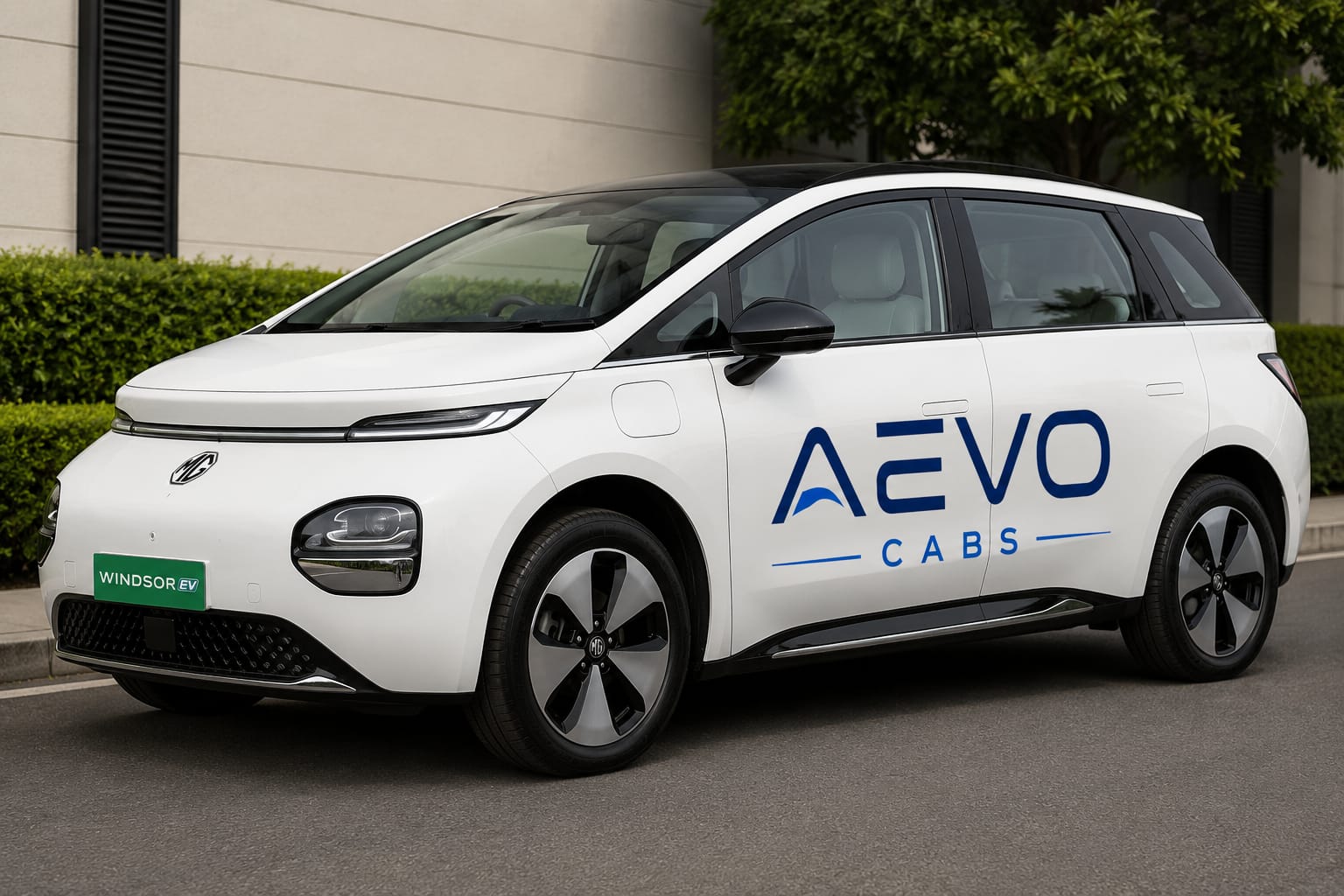
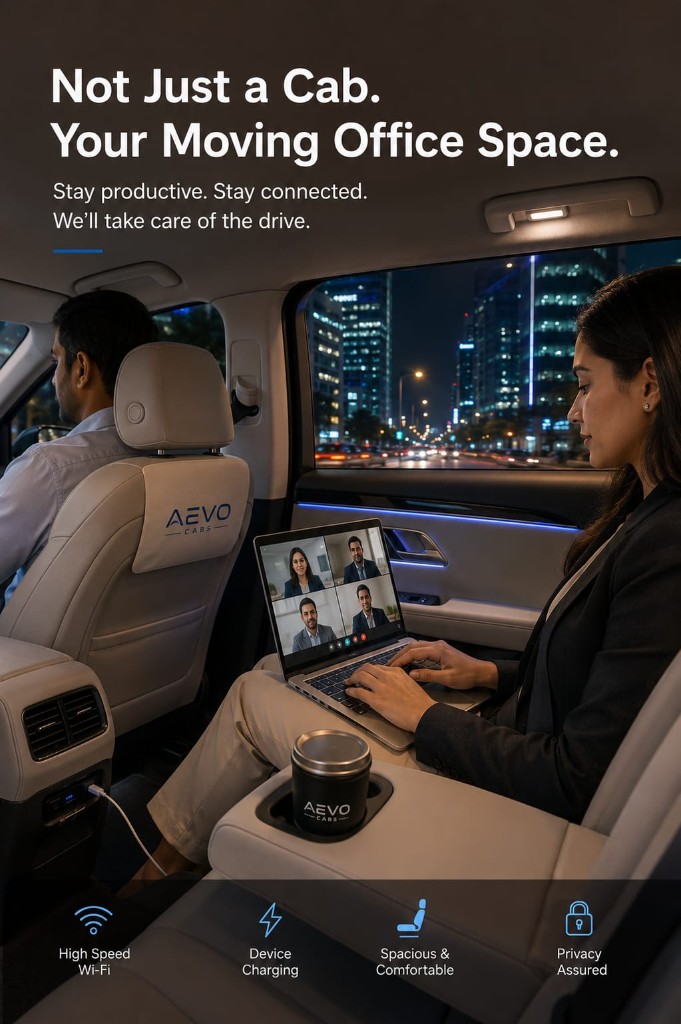
Our fleet — MG Windsor EV, Tata Nexon EV, BYD Atto 3 — wasn't chosen for novelty. Each vehicle was evaluated on cabin quality, real-world NCR range, and the ability to handle back-to-back airport runs without a mid-trip charge panic. Passengers notice the difference immediately: no engine vibration at red lights, no diesel smell on arrival, and climate control that doesn't compete with a combustion engine for power.
“Premium shouldn't be a surge-priced exception. It should be the baseline.”
When you own the fleet rather than aggregate it, every one of those vehicles can be held to a single standard. That's the bet aevo is making: control the asset, control the experience. A rider who books at 7am on a Tuesday gets the same cabin standard as one booking at 11pm on a Friday — not a lottery based on whichever driver happens to be nearby.
The air-quality argument is already here
NCR's air quality crisis isn't abstract for the people who live and work here. Winter smog, year-round particulate load, and the slow health cost of diesel exposure are part of the daily conversation in every corporate tower from DLF Phase 3 to One Horizon Center. Employee transport is one of the few mobility categories where a single decision — which fleet a company uses — can move a measurable number of tailpipe kilometres off the road overnight.
An all-EV fleet doesn't solve NCR's air problem on its own. But it removes an entire category of emissions from the commute corridor: the daily office run, the airport transfer, the client visit across Gurgaon. Multiply that by a hundred vehicles running twelve hours a day, and the arithmetic starts to matter — not as a press release, but as a line item a sustainability team can actually report.
The corporate ESG dividend
For the companies headquartered in NCR, employee transport is increasingly a reported number. An all-EV fleet turns a cost line into an ESG asset — measurable, auditable CO₂ savings on every trip, delivered as a monthly report rather than a guess.
We've built our corporate dashboard around this reality. Every trip logs distance, energy consumed, and CO₂ avoided versus an equivalent diesel sedan. Finance teams get clean invoicing; sustainability teams get data they can drop straight into an annual report. The transport budget stops being a black box.
The companies moving first aren't doing it for optics alone. They're doing it because their employees have started asking — quietly at first, then in exit interviews — why their employer subsidises diesel commutes while publishing net-zero targets on the website. All-EV premium mobility is the rare initiative that satisfies both the boardroom and the back seat.
What comes next for NCR
We're starting where the demand is densest: Gurgaon's corporate spine, IGIA airport corridors, and the daily routes that account for the highest trip volume. The goal isn't to be the biggest cab company in NCR. It's to prove that an all-EV, company-owned, premium fleet can outperform aggregators on reliability while eliminating tailpipe emissions entirely.
If you're responsible for how your organisation moves people — or you're simply tired of rolling the dice on your morning ride — we'd welcome the conversation. The diesel commute wasn't inevitable. It was just the default. Defaults can change.